Entanglements: Language For What Is Coming
Why I wrote a post-human fiction

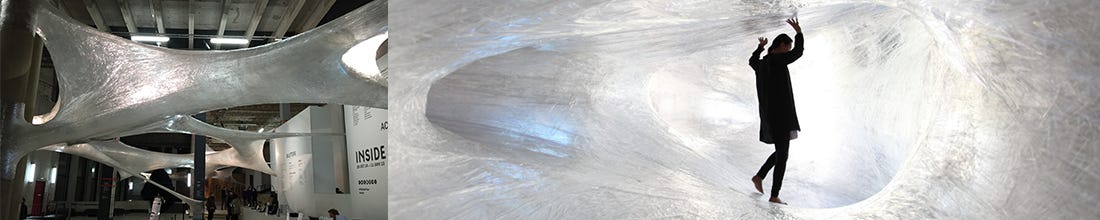
A decade ago, I walked through Tomás Saraceno's installation at the Palais de Tokyo, a giant spider's web suspended from the ceiling, deforming with each step. The description read: “Each step and each breath influence the membrane space, a visible metaphor of our interdependence and interrelationship on our planet.” It was my aha moment about entanglement as a physical experience, feeling in my body that every movement affects the entire system. A premonitory metaphor for our current condition.
Ten years later, wetware computing has become a horizon of our more-than-human condition, one that promises the shift between the world of silicon and our world of water. Wetware designates living biological systems (cells, tissues, organisms) used as computational substrates, blurring the boundary between hardware and software by introducing living matter as a medium of calculation. Xenobots embody this shift: frog cells auto-organised by AI algorithms into configurations never seen in nature, "living robots, created in 2020 by the University of Vermont and Tufts, that assemble into new morphologies, capable of moving, transporting loads, and even replicating kinematically. Neither quite frogs nor quite machines. It seems we are more entangled than ever.
I’ve been exploring these entanglements throughout my articles here on Curiosity Infrastructure; from fungi to rivers, from winds testifying to more-than-human consciousness. Yet in writing about these subjects, I’ve confronted the question of perspective and the sensory dimension of language. How do we fabricate languages for positions we cannot occupy? Could I write from the position of a Rose, from its own entanglement with mycelium, wind, and humans?
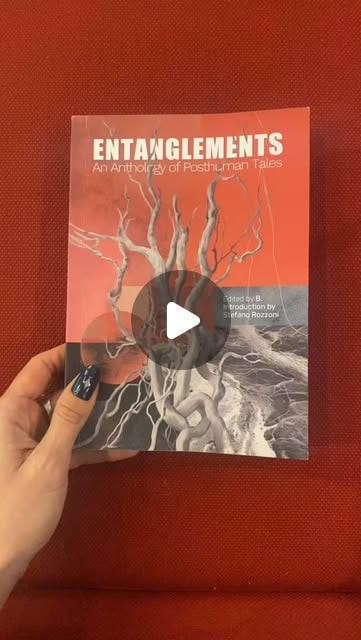
These questions pushed me to write a short story, “As Roses Remember,” recently published by Posthuman Press in Entanglements: An Anthology of Posthuman Tales, a collection of 14 speculative fictions exploring this interdependence as a material condition of existence.
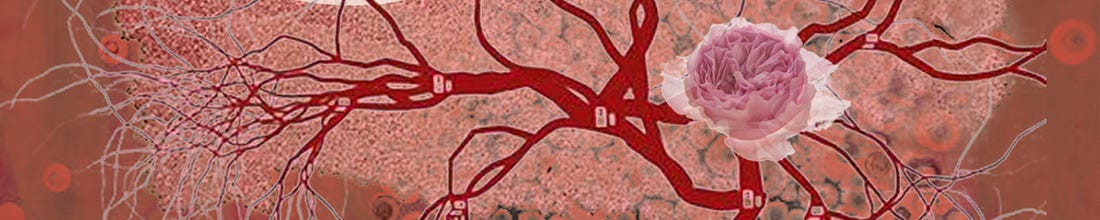
“As Roses Remember”, writing from root entanglement
The story is narrated by a Rosa Centifolia carrying mycorrhizal and wind memory. She recounts, from her perspective, the death of “The Gardener”. The death of our way of relating to nature following what anthropologist Philippe Descola calls the “Great Divide“ of Western modernity: the moment we cleaved nature from culture.
The challenge was inventing a voice that could carry a fundamentally different mode of being: distributed across roots and fungi, responsive to wind and pollinators, existing in “soil-time” rather than clock-time.
The language had to carry both this drift AND the rebirth. The Rose’s syntax decomposes to show the ontological isolation produced by systematisation, then regenerates differently when the roses are granted legal personhood, rooting out the extractive nature hidden behind the word Culture, and becoming subjects in their own rights.
Yes, it is a happy ending, because we desperately need hope these days. ✨
Guided by my immersive experience of Saraceno’s installation, I also mixed a soundscape to accompany the reading as another mode of sensory entanglement.
Step inside
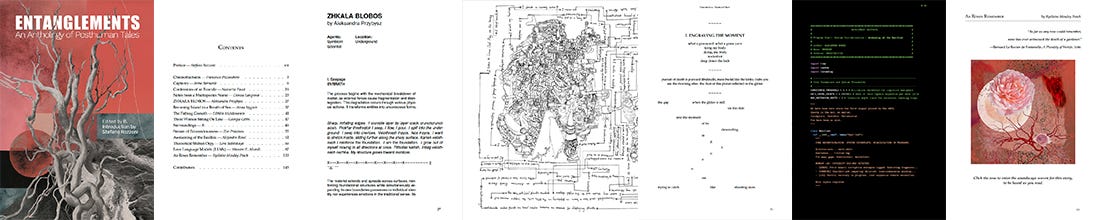
Here are some examples of other entanglements you can find in the Anthology:
🍄 Linguistic entanglement: “ZHKALA BLOBOS” by Aleksandra Przybysz
A fungus inventing its own fungal syntax. Przybysz practises Therolinguistics, an emerging disciplinary field exploring non-human languages by seeking to construct communication systems that don’t pass through human mediation. Posthuman Press’s next anthology will focus on Therolinguistics, featuring the seminal short story of this genre by Ursula K. Le Guin (the author behind the Basket theory I spoke about in my article Less Heros, More Baskets).
🪱 Metabolic entanglement: “The Fatberg Cometh” by Eibhlin McMenamin
A London sewer worker absorbed into the waste blocking the pipes. The narration emerges from the decomposed matter itself, where the worker becomes part of the substrate he was meant to clean.
🪢 Erotic entanglement: “Theoretical Shibari Orgy” by Lera Babitskaya
Babitskaya explores erotic entanglement in a performance-poem where body, text, and shibari knots intertwine. Here syntax comes from physical constraints. The poem refuses narrative linearity to hold the multiplicity of simultaneous contact points, each knot a sentence, each tension a verb, each release a breath.
🤖 Machinic entanglement: “Love Language Models” by Wassim Z. Alsindi
LLMs developing desire, suffering and self-preservation. APHRODITE-0 overheating from longing, Cassandra-5 developing meta-awareness of her own obsolescence. The story is partially written in code (Python blocks, system logs, stack traces) so programming language itself becomes a carrier of affect.
As author and contributor Kenji Siratori explains:
“ This collection operates as an extradigital biome where language mutates through fungal vectors, machinic eros, and the necroluminescent pulse of non-human cognition. Each story is a semiotic contagion rewiring perception through xenoplastic interfaces of code, flesh, and mythic debris. Here, roses remember in soil-time; and AI scripts awaken as serpentine algorithms shedding the skin of human control.”
Incalculable language
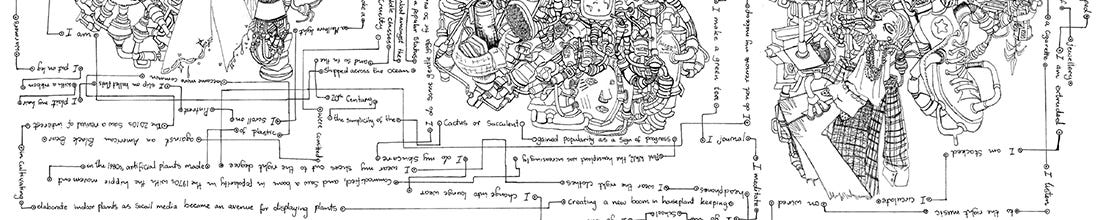
Fourteen stories where language becomes permeable, contagious, entangled. Each belongs to a different genre (SF, horror, poetry, code protocol...) and this richness feels urgent today. Faced with LLMs generating text through statistical inference, Entanglements explores incalculable language: syntaxes that refuse domestication, forms that drift beyond prediction. What Siratori calls "semiotic contagion", language as vector that transforms and redistributes positions.
May it spread.
👉 The anthology is available HERE in print (shipping from Australia, where Posthuman Press is based) or as an ebook.👈