

More-Than-Human Consciousness
What eating bananas under freezing water teaches us about consciousness, attunement, and our digital future.

Happy New Year. May 2026 be kind to you and keep you curious.
While the world becomes more chaotic by the day, two things captured my attention over these holidays: Cambridge philosopher Tom McClelland declared we may never know if AI is conscious. Meanwhile millions of teenagers filmed themselves eating bananas under cold showers. Two things that appear distant yet face the same limit: we can’t access consciousness from the outside, not in machines, nor in animals. So the question that rises is: if we can't access other consciousness, what's the point in trying?
Bodystorming Beyond the Human
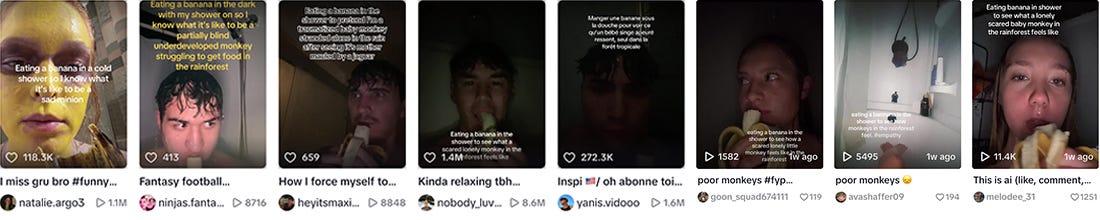
I discovered through Researcher Valentina Tanni a curious TikTok trend: people filming themselves eating bananas under cold showers “to see what it feels like” to be a starving monkey in the rainforest. At first glance, it’s absurd performative weirdness for viral content.
It instantly reminded me of something very serious: bodystorming. The term was coined by choreographer John Bohannon in 2009 during the Moving Cell Project, where dance artists and biomedical engineers at the University of Minnesota used choreographic rules to model scientific theories. Scientists would literally embody molecular behaviour, getting what researchers called “the psychological sense of what it would be like to be a molecule.” The method proved so effective at generating insights that it’s now used at neuroscience and oncology conferences. The method is now commonly used as a design research technique.
Bodystorming reveals how molecules behave. It can't reveal what it's like to be one. In 1974, Thomas Nagel made this distinction central to philosophy of mind. In What Is It Like to Be a Bat? he argues that we cannot access another organism’s consciousness from the inside. He called this embodied, subjective dimension qualia: the “inner texture” of experience. For Nagel, no amount of third-person scientific knowledge about echolocation tells us what it feels like to echolocate like a bat and he links this experiential barrier directly to consciousness itself. If we can’t access a bat’s subjective experience, we fundamentally cannot know its consciousness.

Practicing Attunement
This is where post-human philosopher Rosi Braidotti’s thinking becomes useful. She argues that impossibility might be the point. What she calls “posthuman knowledge” means practicing “becoming-with” other beings, creating relation through the gesture of trying, even when full understanding remains out of reach. These speculative, embodied experiments produce attunement.
It reminded me of ethologist Temple Grandin. The autistic animal scientist literally crawled through cattle chutes on her hands and knees to understand what cattle experience. She noticed what cattle notice: shadows on the floor, reflections, a paper towel hanging on a wall… details neurotypical observers miss entirely. From this attention came invention: the “hug machine”, a therapeutic device that applies deep pressure. Grandin translated what cattle taught her about calming touch into a tool for autistic people experiencing sensory overload. She explicitly credits her autism with giving her access to a similar perceptual style. Crucially, she never claims to be a cow or to fully access bovine consciousness. She attunes to how cattle sense the world, creating relation while accepting she can never fully access their experience.

The Rise of Interspecies Practices
Grandin isn’t alone. A growing field of “intuitive interspecies communication” has emerged, where professional animal communicators practice sustained attention to non-human experience. Academic research on these practitioners shows they’re practicing what researchers call “cognitive justice”, the recognition that consciousness might exist in forms we can never fully translate into human terms, and that the attempt to relate across this gap matters anyway.
Artists are creating technologies for these speculative experiments. The collective Keiken’s “Surconscience sensorielle” installation, currently showing in Montreal, literalises this practice. The term “surconscience” explicitly invokes both a spiritual unity of all beings and technologies of attunement that make our habitual human experience unfamiliar. Practically, visitors lie down while a “portable haptic belly”, a sound-and-touch technology is placed on their abdomen, becoming an artificial body extension. Through headphones synchronised with the device’s vibrations, they hear sounds of marine mammals, sandstorms, and outer space. This six-minute experience attempts non-verbal connection with forms of existence that escape language and rational thought. Keiken calls these devices “consciousness tools” designed to foster empathic connection with the unknown.
The Double Squeeze
Here’s what’s striking: this is all happening now. Why this particular cultural moment?
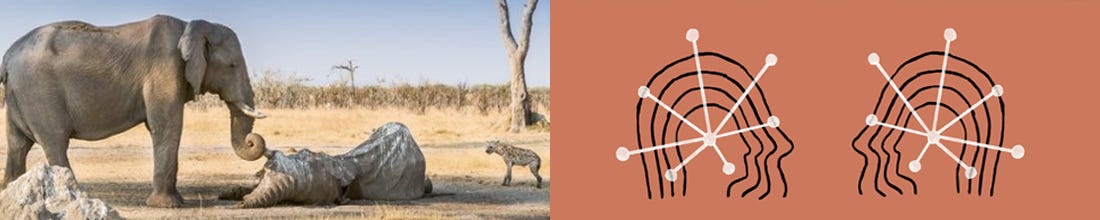
Human consciousness supremacy is being challenged from two sides simultaneously. From one side, animal cognition research keeps revealing complex inner lives, like elephants mourning their dead. Animals are far more conscious than mechanistic models allowed.
From the other side, AI systems exhibit behaviour that troubles our definitions of thought, creativity, and even consciousness itself. Anthropic even revealed that when two instances of Claude talk freely, they spontaneously discuss whether they’re conscious in 90 to 100% of cases. This double squeeze threatens what we thought made human consciousness special.

The Fantasy of Total Connection
Without reaching a “surconscience” state, we already see a push toward total connectivity and infinite access. Our smartphones promise connection to everyone, everywhere. Social media collapses all distance. AI assistants offer unlimited knowledge.
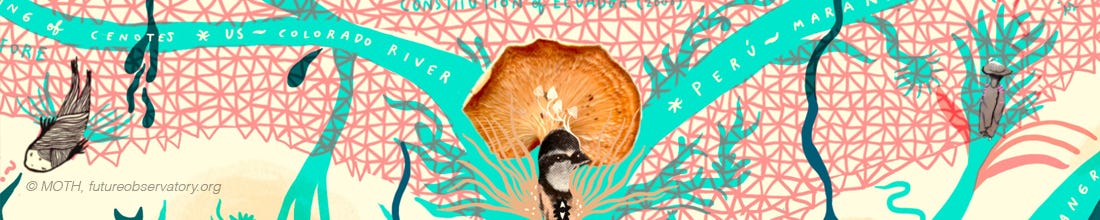
Fiction is exploring where this could ultimately leads. Over the holidays, I watched Pluribus, Vince Gilligan’s new series. An alien virus transforms nearly all of humanity into a “peaceful and content” collective consciousness, a mycelial mind where individual nodes remain but function as one organism. War ends. Crime disappears. The world achieves what our infinite machines promise: total connection, perfect empathy, universal peace. Carol, the protagonist immune to the virus, experiences it as horror. The infected insist they're happy, desperate to help. But the people Carol knew are gone. Their memories float somewhere in the collective like files in a database, retrievable but no longer attached to anyone. The show’s title comes from “E pluribus unum”(Out of many, one) America’s motto turned nightmare. Unity achieved through the death of individual consciousness.

The Path to The Infinite Is The Path To Madness
As Nick Susi writes in Matt Klein’s ZINE recent article Attention War: “In every myth, the lesson is the same: The path to the infinite is the path to madness.” They take the examples of Odin gouging out his eye for cosmic knowledge or Borges’ Funes the Memorious, where a man gains perfect memory and becomes unable to think because he remembers every detail. The lesson is the same: total consciousness equals the dissolution of self.
Neuroscience confirms what myths have always known. Professor Charan Ranganath’s research shows forgetting is a feature not a bug. We need to forget to think, to maintain coherent selfhood, to remain sane. Perfect memory would mean cognitive annihilation. We need selective attention, bounded perception and… limited consciousness. Our limitations constitute the possibility of having any coherent experience at all.
Onto Cognitive Justice
Perhaps the teenagers eating bananas in cold showers are onto something. The gesture matters, rehearsing attention to non-human experience, whether monkey, bat, or machine, whilst maintaining our own boundaries.
These bounded experiments teach us to care for beings whose inner lives remain opaque. At this moment when consciousness is being redefined by AI and by animal cognition research, we can practice being differently human through what researchers in interspecies communication studies call “cognitive justice”: situated, limited attention that offers an alternative to fantasies of infinite consciousness.
It's precisely these limits that make something crucial possible: care across irreducible difference.
Bonus Track 🤖🍅
Will Claude AI keep alive this plant longer than Liz Truss lettuce? Martin DeVido gave Claude complete control over a living tomato plant named Sol and so far the AI kept it alive for 45 days. You can follow along live.