

Wetware Is Coming
From rented humans training robots to brain-cell-powered data centres : where is computing heading?

Curiosity Infrastructure is a newsletter about how we relate to a world that keeps exceeding our categories. If you’re new here, welcome.
Yann LeCun just raised $1 billion to build an AI that understands the physical world. The argument: LLMs predict the next token, they do not understand how gravity works, how objects collide. His JEPA architecture learns from continuous sensory data instead: video, audio, lidar, the actual texture of physical reality.
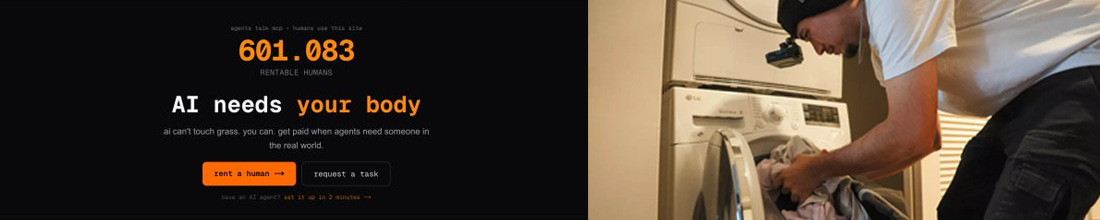
While we wait for that model, a new gig economy has emerged to bridge the gap. In Los Angeles, Instawork is handing out headbands with cameras to workers who record their every move at home so robots can learn how to do chores. Rent a Human books people to photograph school buildings, visit restaurants and report on the taste for agentic AI workflows that cannot yet sense the physical world and is outsourcing that sensing to human bodies.
It reminded me of what Author Joanna Maciejewska once said: “I want AI to do my laundry and dishes so that I can do art and writing, not for AI to do my art and writing so that I can do my laundry and dishes.” A fair ask. Except the workers strapping cameras to their heads in Los Angeles are already doing the laundry. Literally.
Intelligence scaled through body extraction is one response to this physical/digital gap. I’ve been documenting it in When extraction becomes ambient. But a parallel lineage in design research is asking a different question: what if the material itself had agency?
Material agency
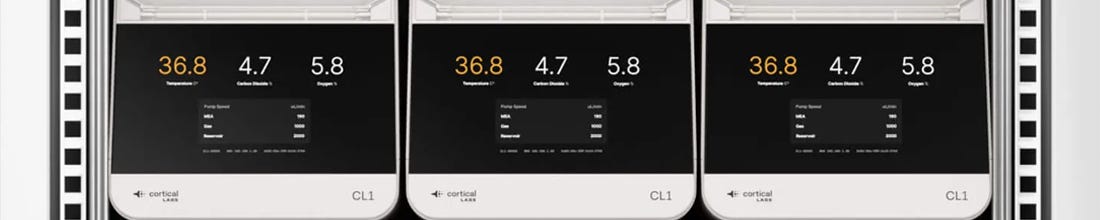
Cortical Labs is building two data centres powered by human neurons: around 200,000 per unit, grown from stem cells, kept alive by nutrient flow and waste filtration. This is wetware computing: unlike conventional silicon-based AI, where neural connectivity is modelled digitally, wetware directly integrates living matter. Its organisation materially enacts cerebral cognitive processes rather than modelling them digitally.
I came to this through Laura Tripaldi’s podcast interview. Tripaldi is a researcher at the Center for AI & Culture of NYU Shanghai, and her work is built around one central claim: matter is not a neutral carrier on which we inscribe intelligence. In her essay Substrates Unbound, she writes that material substrates hold “intrinsic agency and power,” that they are “unruly companions of invention” rather than passive supports of universal functions. Listening to her podcast, something shifted in how I was reading the news about Cortical Labs. She tracks biocomputing systems like DishBrain, living neuronal cultures interfaced with silicon chips that do not execute pre-given code but reorganise, learn, and adapt. Human neurons perform differently under identical training conditions. The same prompt produces different outputs depending on the matter computing. This is what material-centred design research has been arguing from a different angle: intelligence is not substrate-indifferent. It never was.
Soft robots and the question of care
Soft robots make that claim tangible. They have no rigid skeleton, no servo motors, no programmed sequence of actions. They are machines whose movement emerges from the properties of their material, inflates and deflates, contract under heat or light, or respond to magnetic fields.
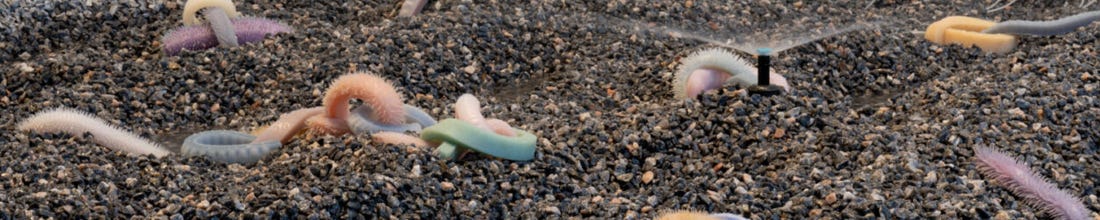
When I came across AFTER CARE, a work by artist duo Rhoda Ting and Mikkel Bojesen part of the Soft Robots exhibition at Copenhagen Contemporary, something stopped me. Around fifty small pneumatic robots wriggle and burrow in a pit of rocks and dirt. The work carries an explicit design intention: to invent a way of caring for synthetic life. The artists describe their practice as one of listening and co-creating with non-human species, synthetic life included. The softness of the material is central to that intention: a material that responds from its own physical disposition, that deforms, recovers, and reacts to pressure, opens a space where tending becomes possible.
AFTER CARE poses the question of caring for synthetic life at the scale of an art installation. Wetware computing makes it an engineering requirement.

Metabolic computing
In a conventional data centre, if maintenance fails, the servers stop. When the computational substrate is alive, it metabolises: it consumes, produces waste, ages and dies. The difference seems simple but it points to something deeper: every object has a way of being in the world that exceeds what it does for us. The dependency is constitutive. Operating and keeping alive have become the same gesture. That has never been true of infrastructure before.
This question is older than we think. Tripaldi traces this ambition back to the alchemical homunculus : a medieval attempt to grow a synthetic human in a sealed vessel, fed on blood and milk, made to think and speak on behalf of its maker. The ambition is the same as Cortical Labs: make matter think on our behalf. What differs is the scale… and the electricity bill.

Who do we want to tend for?
And here is the great irony: we are building machines to replace human labour, and those machines now require something close to human care. Tending, feeding, keeping alive… like us. 🙃
It’s also worth keeping in mind that while we are theorising giving care to robots, the documentary Overseas by Sung-A Yoon reveals a surrealist school where Philippine women train to endure conditions close to slavery to prepare them to clean the homes of the wealthy abroad. The same chores the workers in Los Angeles are teaching robots to do. Maybe it's time to get our priorities straight.
Bonus track: things that caught my attention
🪰 A fruit fly brain running a simulator (by Eon Systems)
⚔️ An artist finds out who will win the AI war (by @artificial.isabel)
💍 A ring that proves the wearer is human (by design studio Modem)
Great insights!! Tx Rys
Love your conclusion….