

Opposites entangled: the Pretzel Theory
Navigating the polarised cultural landscape of 2026

This year brought a peculiar sense of disorientation. Cultural elements I had long associated with counter-culture or emancipatory potential resurfaced in moral universes that felt radically opposed to my own. How did we get there?
The return of Neo-Luddism
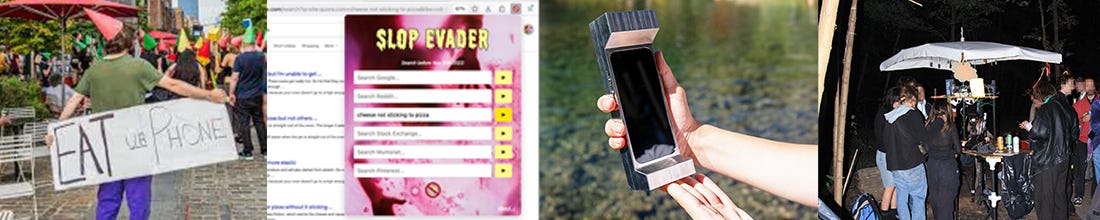
Take the revival of the Luddite movement. The original Luddites were early 19th-century English textile workers that destroyed industrial machines from a precise political diagnosis: those machines were reorganising labour, concentrating power, undermining skilled work and eroding social protections. The parallel with AI today practically draws itself, and we see the term “Neo-Luddite” resurface on the cover of The New York Times , spotted by Rivista Studio, or cited as a defining trend in Dentsu’s Creative Report for 2026.
I’ve observed this revival manifest through different signals: people declaring themselves “AI Vegans”, browsing the web through plugins like Slop Evader, (which hides any content written after 2022, the year LLMs achieved mass adoption), designing iPhone cases so heavy they physically discourage use, or gathering at Outdoor Computer Parties, forest raves where files circulate hand to hand on USB keys, a kind of ritualised peer-to-peer exchange reclaimed from the digital.
Part of this resonated deeply. These gestures articulate a desire for an ecology of attention, a deliberate reclaiming of agency from systems engineered to extract our time, data, and cognition. Yet these same forms carry another charge entirely, one that slides into fantasies of purity where disconnection hardens into moral stance and where refusal becomes its own ideology.

When polarisation bends into a pretzel
I was caught in these reflections when Laurent François shared with me a paper from the think tank Office of Applied Strategy (OAS), The New Pantheon. It offered a framework that crystallised what I’d been sensing but couldn’t yet name. The paper states that in a context of extreme polarisation and eroded shared narratives of progress, opposing ideologies converge on similar practices, objects, and even aesthetics. They call this the “Pretzel theory”.
Drawing on Jean-Pierre Faye’s horseshoe theory from the early 1970s, where political extremes form a U-shaped spectrum, the far left and far right sharing structural similarities despite opposing values, OAS extends that metaphor:
“Today, the extreme polarization of society has strained the U-bend of the horseshoe so much that its polarities have snapped back together and become entangled, much like a pretzel.”

Mushrooms supplements and parallel exits
OAS illustrates this through a particularly revealing case: mushroom supplements. In the West, mushrooms have long signalled distance from pharmaceutical and institutional science, as a marker of alternative medicine. Following the Pretzel theory, that marginal signal has flattened entirely.
On opposite ends of the ideological spectrum, lifestyle wellness brand Goop and conspiratorial nationalist media brand Infowars promote the same functional products: cordyceps and maca mushroom supplements. One embeds them in a vocabulary of pleasure and intimacy (“Sun Potion”,“Sex Dust”), while the other frames the same product through national vigilance and virility (“Wake Up America”,“Super Male Vitality”).
The same substance circulates across incompatible worldviews but it answers a shared condition: institutional distrust. Its capacity to carry two opposing moral stories is precisely what reveals the phenomenon OAS describes: polarisation no longer produces distinct futures, but rather generates parallel exit strategies from a shared sense of systemic betrayal.
Somatic Intelligence and the return of the body
This dynamic reappears in one of the strongest signals for 2026: the return of the body as a site of truth. As cognitive authority erodes, from institutions, from experts, and now from AI, the body is increasingly mobilised as the last remaining ground of certainty. This shift has been identified by NextAtlas as “Somatic Intelligence” in their Unknown Unknowns 2026 report. And here again, this signal does not produce a single imaginary. It bends into a Pretzel. Let’s take the example of emergent practices with a focus on Interoception, the art of listening to the signals our body sends to our brain.
On one end, interoception shows up collective, explicitly anti-racist embodied practice. Somatic Abolitionism, developed by Resmaa Menakem, treats the body as a site where history and power are felt: it aims at training somatic capacity through repeated communal practice. It’s explicitly about culture-building, not upgrading: learning to stay present to discomfort, widening the capacity for relation, and rebuilding trust through the nervous system, together.
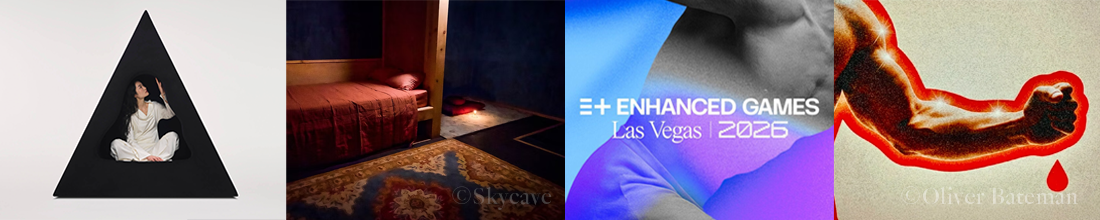
On the other end, we have “luxury dark retreats”. At Skycave Retreats or at Evodark Retreats, guests are advised to stay three to four days in the darkness while staff provides food delivery service and daily check ins. It claims radical rejection of 24/7 culture and a “sensory reset” that forces deep interoception by removing visual reality entirely. And idea that we also find at a smaller scale in Bischiyano’s Cave Chair.
These two approaches oppose each other symbolically. Yet they bend away from the same external pressure: a techno-pharmacological model of the body framed as a system to be continuously optimised. This body optimisation horizon is epitomised by projects like the Enhanced Games, scheduled for 2026 in Las Vegas, which openly embrace pharmacological and technological augmentation as the future of sport and human potential. It also strangely resurfaced in Silicon Valley through a practice I thought long confined to the incompetent doctors of Molière’s Imaginary Invalid: blood letting, that became a trendy biohacking ritual supposedly resetting metabolism, sharpening focus, or prolonging vitality.

The risk of reading convergence as equivalence
The Pretzel theory describes a moment where form no longer reveals intention and where radically different projects adopt similar gestures to cope with the same systemic pressures. At this juncture, a specific risk emerges: mistaking convergence for equivalence.
Just because two practices look alike doesn’t mean they produce the same world. The mushroom supplement from Goop versus Infowars may be molecularly identical, but it’s embedded in entirely different epistemologies, different relations to authority, different stories about what bodies are for and what futures are possible. Aesthetics, gestures, even objects themselves tell us remarkably little. What begins to matter instead is the quality of encounter they produce.
This is where my initial discomfort with the Neo-Luddite revival was coming from. On the surface, many of these practices appear similar. But they produce profoundly different situations. Some forms of slow tech recombine connections differently, exposing bodies to one another, circulating knowledge hand to hand, producing collective presence. For others, withdrawal becomes a test of virtue between the “pure” and the “contaminated.” In those cases, it insulates.
From intentions to consequences
Becoming aware of the Pretzel theory sharpened something I had already been grappling with: how to trace what tools and behaviours actually do once they are taken up in real contexts, beyond their stated intentions or declared values. The Pretzel raised the stakes by making this gap unavoidable. In a landscape where identical forms circulate across incompatible worldviews, what matters are the consequences they produce, the second-order effects they trigger, and the kinds of situations they bring into existence.
This is the line of inquiry I proposed to explore at SXSW 26: how future visions behave once released into the world, and how to identify unintended effects early enough for those visions to remain viable rather than collapse under their own contradictions. In a Pretzel shaped world, the task shifts toward tracking consequences rather than intentions into the realities they actually reshape.
Bonus track, some inspiring links for the holidays 🎄
🌊 Susan Murphy Roshi explores why we need haikus amid the climate crisis on the excellent Emergence Magazine
🍄🟫 The quirky Fungi film Festival is back and their movies are streaming all month!
🕸️ In Designing the more-than-human city, Critical Playground explores urban systems evolving through multi-species infrastructures and sensing networks