

Futuring through discomfort
How to deal with signals we would rather avoid

I came back from Future Days in Copenhagen, three inspiring days among people like me, who imagine futures for a living. On my arrival back home I learned that the Major Oak, the oldest European tree had died in Sherwood Forest. Gone after a run of hot, dry summers. I read the news during the worst heatwave Europe has known. A 2014 France Télévisions broadcast resurfaced that week, a fictional weather forecast set in August 2050, made to warn about climate change. Next to it, the channel’s real bulletin for 22 June 2026, the temperatures were worse than fictional 2050. And there I was, in a room, forecasting 2077…
The easy conclusion is to put 2077 down and deal with June. But refusing the long view is also refusing the job; foresight that collapses into survival stops being foresight. That long view is exactly what Future Days did well: three days of sharp conversations among inspiring people. So why did I come home suspecting that the future was taking shape in the places we were not looking?
The suspicion comes from the foresight outcome that impressed me the most, ever. Félix Guattari in The Three Ecologies, published in 1989, following economic power and media attention, read Donald Trump, then a property developer, as the epitome of the powerful figure our century would produce. He wrote:
“Just as monstrous and mutant algae invade the lagoon of Venice, so our television screens are populated, saturated, by ‘degenerate’ images and statements. In the field of social ecology, men like Donald Trump are permitted to proliferate freely, like another species of algae, taking over entire districts of New York and Atlantic City”. (Felix Guattari, 1989)
This is wildly ironic to see Trump cast as an invasive algae by Guattari thirty seven years ago, now that the water of the Lincoln Memorial Reflecting Pool has turned algae-green under his own renovation, read this week as a metaphor for his presidency. Parenthesis closed 🙃.
Without pretending to follow the same rigour as Guattari in his research, following where economic power and media attention leads, we can only notice an uncomfortable signal this week: Masculinist influencer Clavicular opened the 424 show at Paris Fashion Week in the courtyard of the Musée des Archives Nationales, while one day later the French Senate, drawing on a report from the DGSI (the French MI5), named masculinism an emerging terrorist threat. Rightfully so: days earlier in Montreal, a self-described incel shot two people dead and left a 104-page masculinist manifesto as an explanation.
How do you include signals that are not part of your preferable futures in your practice?
Answering this means holding two kinds of discomfort, both of which actually ran through Future Days. In the present, staying with what is dying, composting it, instead of rushing to fix it (part 1). In the long term, asking who carries each rival version of longtermism, and whose future it quietly serves (part 2).
Part 1: Composting the present
One model was everywhere at Future Days, in the talks, the workshops, the exhibitions: the Berkana two-loops framework. Two overlapping curves, one system in decline, another rising. The practitioner gets a role in each. You hospice the old one out and you midwife the new one in.
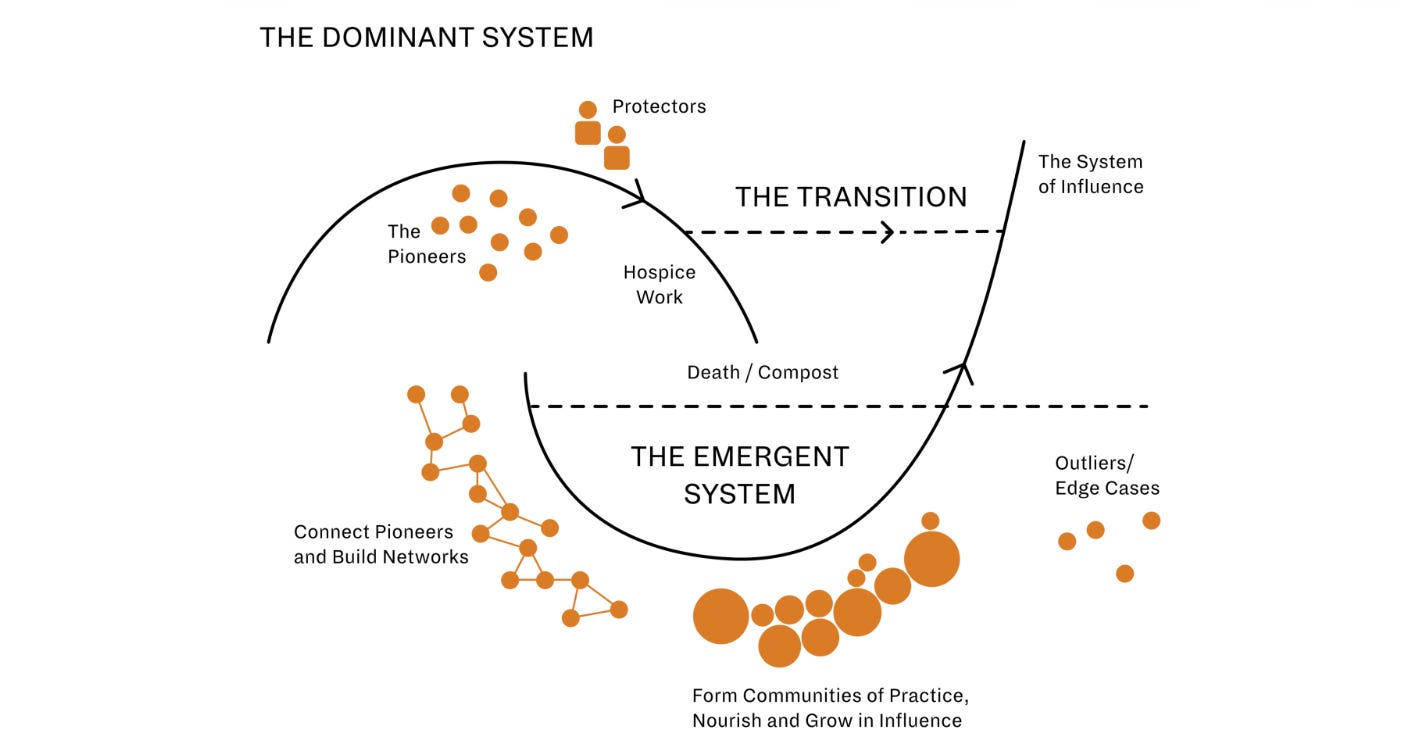
I read the omnipresence of this model as a symptom of a transition Antonio Gramsci already named. His famous quote came up more than once at Future Days:
“The old world is dying, the new struggles to be born”. (Gramsci)
Most stopped the quotation there, but I find the remaining part of the quote revealing:
“…In this twilight, the monsters appear”. (Gramsci)
By monsters, Gramsci meant the fascism rising around him in the 1930s. That is the warning Berkana's gentle language leaves out. The model lets you hospice a dying system tenderly; Gramsci reminds you what crawls out of it while you do.
Still, the model gets one thing right: death and compost are central to it. I have written before, in the fungal revolution, about why fungi are the perfect metaphor here: they live off death, turning rot into the exact condition for new life.
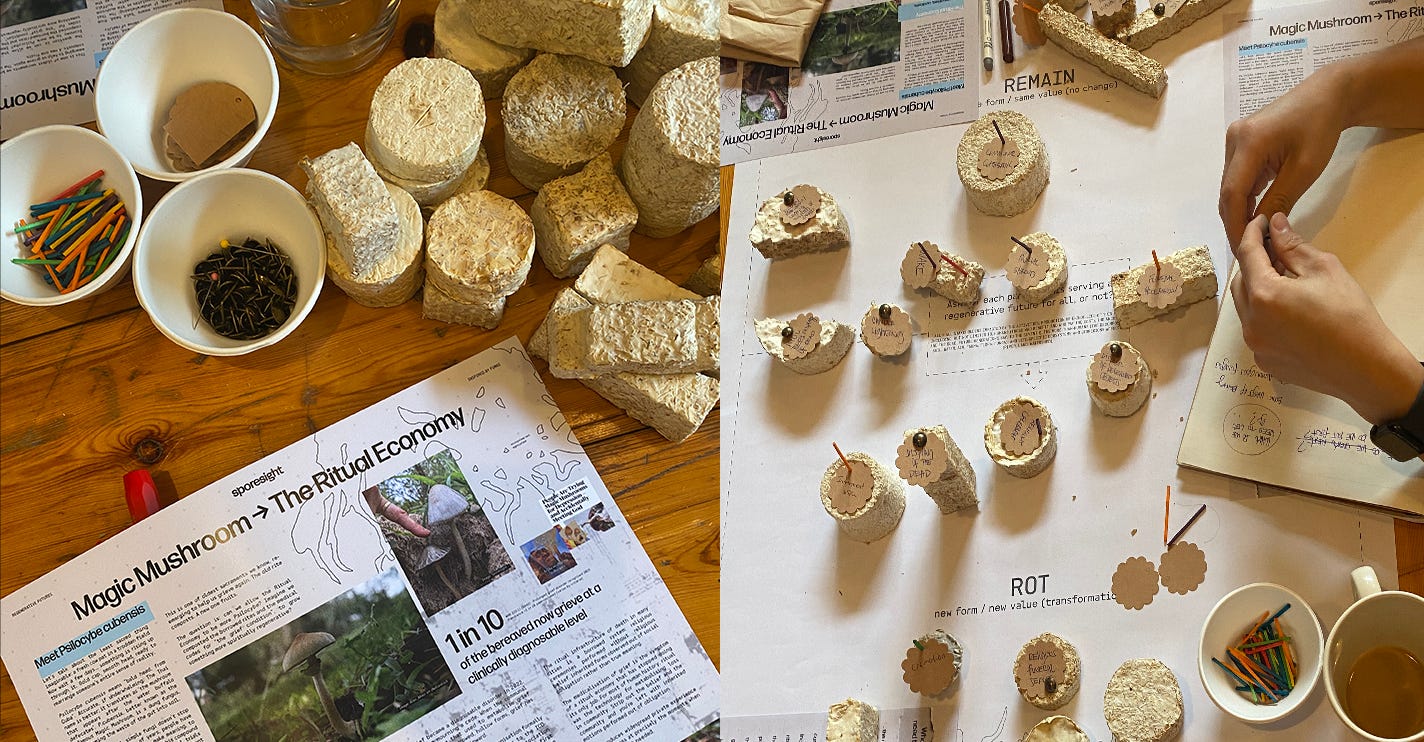
So I’ve put this theory in practice in a workshop with Sporesight with Jess Jorgensen and Allyson Shane Carroll. Starting from the properties of fungi, we sorted what could be left to rot from what could be regenerated in the “economy of death”.
Composting means staying with a thing as it breaks down and seeing what it becomes. Working from the turkey tail, a fungus that digests dead wood into medicine for the living, we let the funeral planner rot. What grew back was a funeral fairy, no longer processing the dead but staying with the people they leave behind. That idea only came from staying in the decay instead of reaching for a clean fix.
Composting keeps you in the present, hands in the rot. But the present is not enough. What you do with it depends on the future you think you are walking into, and here the path forks.
Part 2: Debunking Longtermism
The Good Ancestor Longtermism
Much of the long-range thinking present at Future Days borrowed, openly or not, from The Good Ancestor, as Roman Krznaric’s eponymous book states: act for generations you will never meet, plant for shade you will not sit in. It is the logic of cathedral thinking.
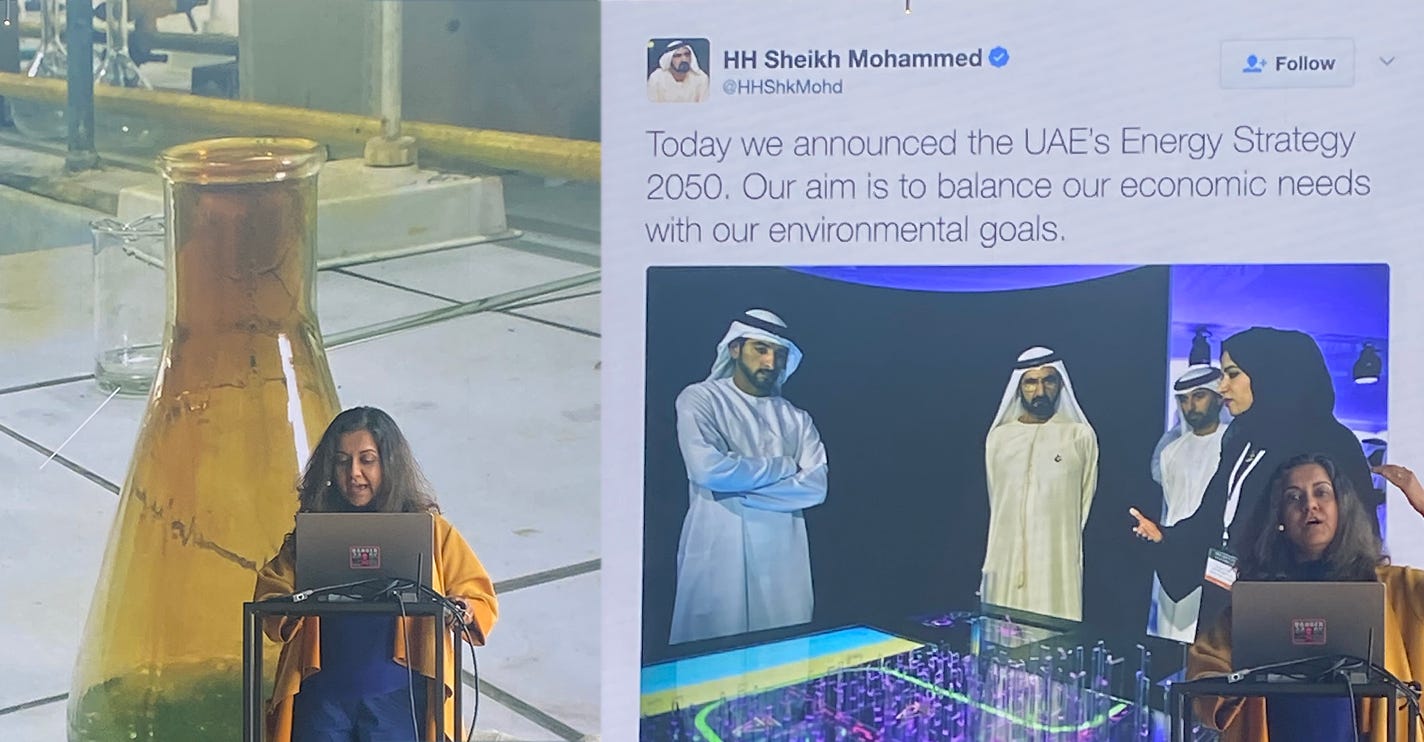
One Good Ancestor example was Anab Jain’s talk from Superflux at Future Days. She recounted a Gulf urban project where decision-makers were resisting cutting car traffic. So her team reproduced the exact air their children would breathe in that future, made it in a lab, and let them sit in it until they changed their minds. And they did! The point, as Jain put it, is that :
“we know the world in more ways than the analytical one. Kinaesthetic, sensory, emotional, embodied”. (Anab Jain)
She treats these as forms of intelligence in their own right. The fabricated polluted air makes them know it with the body, and that knowledge moves them where the chart cannot.
The Good Ancestor taken seriously can also be uncomfortable. That is what happened to me in Atlas 2077, a prospective workshop held by Transformative Times during Future Days. A hundred of us were handed territories in a world in water crisis. I spoke for a sinking coastal city. To protect the coast, we granted it legal rights. It used them: by the end we had to evacuate, because the coast, given a voice, no longer wanted humans on it. You set out to give the agency to the living, and it expels you from the picture. Tough but fair scenario.
Even inside that exercise, I caught myself thinking it was all very well, but the longtermism with substantial economic power behind it is serving a different political project entirely.
Strong Longtermism
At the opposite of the Good Ancestor stands Strong Longtermism, the position developed by William MacAskill, co-founder of the effective altruism movement. According to this vision, the far future matters morally more than anything else. The core argument is that statistically, weighed against the trillions who might one day be born, the people alive now count for almost nothing. It is a philosophy of sacrifice. So far, you could almost read it as a noble goal, until you ask how that future gets built, and by whom.
This is where the philosophy meets the portfolio. Behind this ideology stand Silicon Valley fortunes, and the most telling is the libertarian billionaire Peter Thiel. As a lifelong disciple of philosopher René Girard (the thinker who placed sacrifice at the origin of every social order), Thiel put it plainly back in 2009: he no longer believes freedom and democracy can coexist. Follow that logic and the future belongs to the few who can steer it, while the present becomes something to control on the way there. Thiel's Founders Fund sits behind Palantir, which helps governments track and deport people, and Anduril, which builds autonomous weapons and border surveillance. These are the tools for controlling a present that might get in the way of the chosen future, and the ones sacrificed are those on the wrong side of it. So the people teaching us to discount the present are the people funding the future they want to run.
Faced with a civilisational project this well funded, it is tempting to feel powerless. But the game is not lost. It just cannot be won on the ground of abstraction because their entire Strong Longtermism project turns everything alive today into an abstraction. This is why I found what Anab Jain presented so precious: she changes the ground entirely, making the future breathable, real, present in the body, where no spreadsheet can reach. To me, that is the urgent answer to a disembodied longtermism.
Conclusion: follow your discomfort
Whichever future we choose to fund or fight, the present is already sending its bill. The Major Oak didn’t die of a surprise: we forecast this heat in 2014 and watched it arrive anyway. The tree kept its side of the bargain for a thousand years; we couldn’t manage a decade… Meanwhile, there is an urgency. The monsters Gramsci warned about are already here, on the runway and in the headlines.
So, a few practical ways to act on the signals you would rather not see when futuring:
Compost the discomfort: Put it on the strategy table and analyse the ground it feeds.
Practise negotiating across diverging interests: Sit down with the human and the non-human alike, the way Atlas 2077 had us do.
Create memories from the future: From future artefacts to world-making, immerse decision-makers in the future with all their senses.
Rehearse many futures: Run several simulations of future scenarios and set yourself alerts to see which one is starting to arrive.
Stay flexible in the chaos: The future has more imagination than we do. You can trace every third-order consequence and still not see what is coming, so build for adaptation.
In the end, I went to Copenhagen to be inspired and left unsettled instead, which is the more useful thing to carry home. I suspect that shift, from inspiration to discomfort, is the one the foresight field is starting to make, to meet what is coming.
Very enjoyable read, Ryslaine! A thoughtful, informed take on FD 2026 grounded in plurality
Loved the expansion of the Gramsci quote, and it actually brought to mind a different quote entirely: we live in a twilight world, and there are no friends at dusk.
That’s actually from the film Tenet, which many people have dismissed as a confusing Nolan spy thriller, but really it’s about intergenerational climate-related conflict. The future is at war with the present.
It’s a more cynical quote but also reframes the Gramsci one towards more urgency in the present. My own attention is starting to shift away from foresight to insight, as the pressure of the present gets turned up through heatwaves and the like. Climate adaptation over big picture systemic thinking. I kind of wish FD 2026 involved some of that. In Arabic, the word for future literally means “that which is coming”. We may be great at discussing the next decade+, but are we ready for what’s round the corner?
FD 2026 often felt like we still have the luxury of time on our side. Even using the time horizon of 2077 felt absurd. As you say, its moments of feeling unsettled were arguably its most powerful.
Reading this, I kept circling something Doug Bierand says: mycelial change is subversion of an unsustainable status quo. And your piece made me wonder - what if that's exactly what we're doing in the in-between?
I love how you've named that composting (hands in rot) is necessary but incomplete.
It reminds me of fungi that outlive us (for e.g., the 'humungous fungus' Armillaria Ostoyae in Oregon, and countless others) who survive by creating the conditions for resilience, slow growth, and their ecosystem to thrive alongside the breakdown/ because of it.
I think sitting in the discomfort is where we get to not only rehearse different futures but actively subvert the dominant (declining, extractive, monster-built) system through persistence, AND actively create conditions for the ecosystem that sustains us to thrive (emergent, transformative system).
Monsters and Fungi Fairies co-exist. Perhaps the dominant futures of fund and fight will buckle under their own unsustainable weight, as we emerge a slow-grown strong foundation with the pieces of the old systems decaying around us.